

As a developmental comparative physiology laboratory, we examine developmental differences and similarities between species at both embryonic and early natal stages. These stages of an animal’s life often feature key windows of time during which tissues, organs, and organ systems are susceptible to environmental perturbations, such as hypoxia or low temperature. By studying both an organism’s typical and environmentally challenged developmental trajectory, we gain insight into mechanisms that govern homeostasis and metabolism through its lifespan: this in turn has direct effects on the life history and success of the individual.
The main research focuses of the lab are:
Developmental Physiology of Avian Ductus Arteriosus
- Development of endothermy along the precocial to altricial spectrum
This NSF funded research aims to explore and characterize development of endothermy and body temperature regulation in avian species. We have particular interest in how birds with different maturation at hatching, such as precocial ducklings and altricial passerines, obtain endothermic capacity. By examining a variety of physiological characteristics from the whole-animal level down to mitochondria development, we are able to get a detailed understanding of the changes a newly hatched bird undergoes as it matures and develops stronger endothermic capacity. With the help of collaborators in Michigan and North Dakota, we are examining development in altricial Red-winged Blackbirds and Double-crested Cormorants, as well as a variety of precocial species, such as Pekin Duck, White Leghorn Layer Chicken, Broiler Chicken, and King Quail.
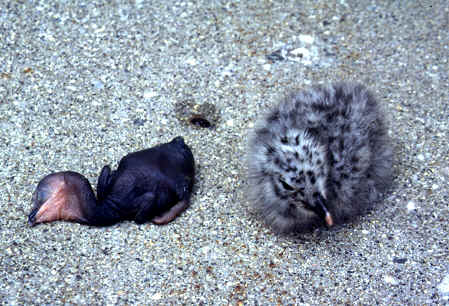 |
Double-crested Cormorant (left) and Ring-billed Gull (Right) showing the morphological differences between similar sized altricial and semi-precocial day old hatchlings. |
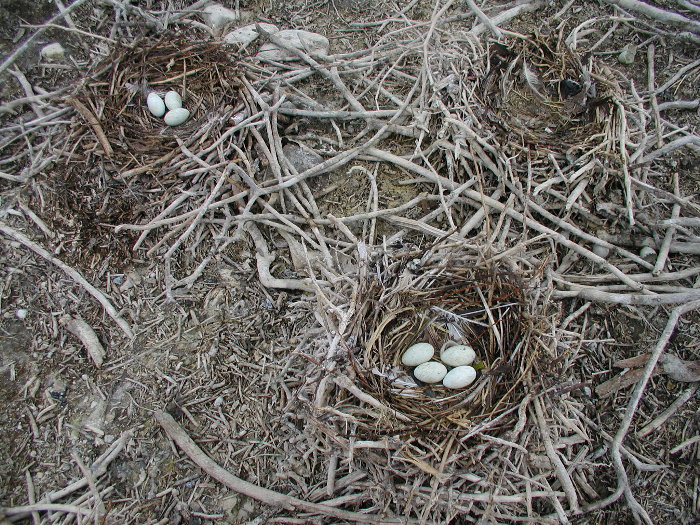
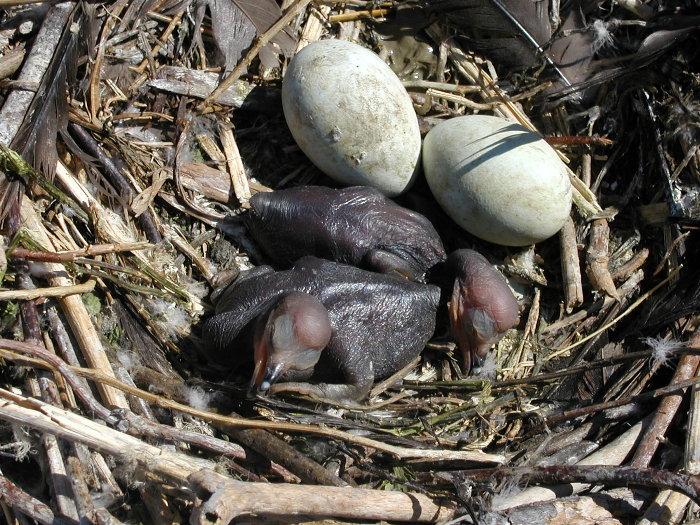
- Hormonal regulation of the development of endothermy along the precocial to altricial spectrum
In addition to characterization of endothermic development, we study the role of hormones, especially thyroid hormone, as a regulator of metabolic development. Our central research question is to test the effect of thyroid hormone on the development of aerobic capacity, focusing on skeletal and cardiac muscle function and metabolism.
Unlike many other animals, the respiratory and circulatory systems of an insect are separate from another. Large insects must actively ventilate their tracheal system in order to deliver enough oxygen to their tissues especially when active or under stress, such as high temperature or low oxygen. This research aims to explore the facultative endothermic insects such as bumble bees and hawk moths regulate ventilation, metabolism, and heat production after developing under hypoxic stress.
Currently funded by the NIH, this research examines the reactivity and closure of the avian ductus arteriosus. The ductus arteriosus provides a right-to-left, fetal shunt in embryonic amniotes. Reptilian and avian species possess two ductus arteriosi and our lab is studying the mechanism of closure in these species and how it is influenced by development in hypoxic conditions.